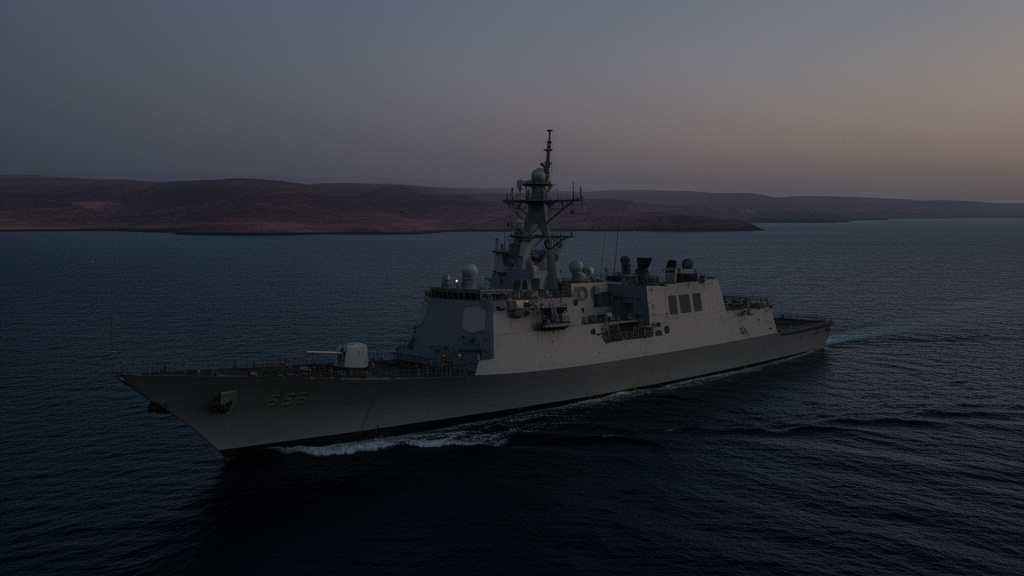
The Middle East has entered a period of extreme volatility as the United States and Iran transition from a long-standing shadow war to an increasingly direct military confrontation. Following a series of ballistic missile attacks targeting U.S. bases in Jordan, the Pentagon has launched heavy airstrikes in retaliation, a move that threatens to draw the region into a broader, uncontrollable conflict. The situation is further compounded by recent drone strikes targeting U.S.-owned assets in Egypt, marking a significant expansion of the conflict’s geographic footprint.
Key Highlights
- Jordan Base Attack: A significant escalation occurred with ballistic missile attacks targeting U.S. military installations in Jordan, resulting in damage to critical infrastructure.
- U.S. Retaliation: In response to the missile strikes, U.S. Central Command (CENTCOM) launched a coordinated series of heavy airstrikes against identified proxies and command-and-control centers.
- Expansion into Egypt: U.S.-owned commercial and military assets in Egypt were subjected to drone strikes, indicating the conflict is now stretching beyond the Levantine corridor.
- Strategic Escalation: The shift from indirect proxy warfare to direct strikes on established sovereign and allied territory marks a dangerous shift in the U.S.-Iran military calculus.
The Strategic Shift in Middle East Combat Operations
The current crisis represents a departure from the asymmetrical warfare that has characterized U.S.-Iranian relations for the past four decades. For years, the Islamic Revolutionary Guard Corps (IRGC) utilized a network of regional proxies to project power and maintain deniability. However, the intensity and precision of recent ballistic missile attacks against U.S. bases in Jordan—a critical American ally in the region—suggests a pivot toward more aggressive, conventional deterrence strategies by Tehran.
The Jordan Base Incursion and Tactical Implications
The ballistic missile strikes on the U.S. installation in Jordan serve as a watershed moment. Unlike previous rocket attacks, which were often localized and intended for harassment, the use of ballistic missiles signifies an escalation in technical capability and intent. These systems are significantly more difficult to intercept and cause exponentially higher structural damage. The attack on this specific base, which serves as a logistical and intelligence hub, has forced U.S. Central Command to re-evaluate force protection measures across the entire theater. The precision of these strikes implies the use of sophisticated targeting data, suggesting a higher level of planning and support from the IRGC.
U.S. Retaliatory Operations: A Forceful Response
The Pentagon’s response has been swift and kinetic. Utilizing assets from the U.S. Air Force and regional partners, the U.S. conducted a series of heavy airstrikes aimed at degrading the infrastructure responsible for the initial attacks. These operations were specifically designed to disrupt the supply chain of missiles and drones provided to militant groups. By targeting command-and-control centers, the U.S. is signaling that the “shadow war” dynamic, where attacks go unanswered or are met only with minor diplomatic sanctions, has concluded. However, military analysts warn that these retaliatory strikes are a double-edged sword; while they aim to restore deterrence, they simultaneously invite further escalation from Tehran, which has vowed to respond in kind.
The Egypt Theater and Maritime Security Concerns
Perhaps the most alarming development is the reported drone strikes on U.S.-owned assets in Egypt. Egypt has long been a stabilizing force in North Africa and a crucial partner in maintaining the security of the Suez Canal. By extending the conflict to Egyptian soil, Iranian-aligned forces are attempting to pressure the U.S. from multiple flanks, complicating the logistical reality for the U.S. Navy and commercial shipping alike. This expansion poses a direct threat to the Red Sea maritime security corridor, a vital artery for global energy supplies and international trade. If the security of these assets continues to deteriorate, the economic shockwaves will likely extend far beyond the immediate region, impacting global oil prices and shipping insurance rates.
Secondary Angle: The Economic Risk to Global Energy Markets
The escalation is already impacting the global economy. As conflict spreads to Egypt and the Red Sea corridor, commercial shipping companies are being forced to re-route vessels, adding weeks to transit times and significantly increasing freight costs. Energy markets, highly sensitive to instability in the Middle East, have reacted with increased volatility. Should the conflict escalate to a point where the Strait of Hormuz is threatened, or if critical infrastructure in Egypt is incapacitated, the resulting spike in energy prices would create a significant headwind for the global economic recovery, complicating efforts by central banks to control inflation.
Secondary Angle: The Shift from Proxy Warfare to Direct Confrontation
Historically, the U.S. and Iran have avoided direct conflict to prevent total regional war. Tehran’s willingness to risk such a confrontation indicates a strategic miscalculation or a belief that the U.S. lacks the appetite for a sustained regional campaign. Conversely, the U.S. strategy of “measured retaliation” is currently being tested. The core challenge for the Biden administration is to demonstrate resolve without triggering a full-scale regional war that would require massive deployment of U.S. ground forces—a scenario that remains politically and strategically undesirable.
Secondary Angle: Diplomatic Fragility in a Hot War
Diplomacy often requires a degree of separation between political leaders and military actions. However, with the current rapid pace of strikes and counter-strikes, the diplomatic space for de-escalation is shrinking. Traditional back-channel communications, which usually serve to prevent miscalculation, are currently failing to contain the situation. The international community, particularly European allies and regional neighbors, is increasingly alarmed, urging both Washington and Tehran to establish new, albeit fragile, red lines to prevent the current skirmishes from spiraling into a catastrophic multi-front war.
FAQ: People Also Ask
Q: What is the significance of the attacks in Jordan?
A: The attacks in Jordan are highly significant because they targeted a U.S. military hub using ballistic missiles. This signifies a move away from low-level proxy attacks to more sophisticated, high-impact warfare that directly challenges U.S. regional infrastructure.
Q: Why is the expansion of strikes into Egypt a major concern?
A: The strikes in Egypt are concerning because they threaten the stability of a key U.S. regional partner and jeopardize the security of the Red Sea shipping corridor, which is essential for global trade and energy transport.
Q: Does this escalation mean the U.S. and Iran are at war?
A: While there is no official declaration of war, the two nations are currently engaged in a period of active, kinetic military confrontation. Both sides are attempting to calibrate their responses to exert pressure without triggering an all-out, full-scale regional conflict.
Q: What are the primary objectives of the U.S. retaliatory strikes?
A: The primary objectives are to restore deterrence, degrade the military capabilities (specifically missile and drone stockpiles) of militant proxies, and send a clear signal that attacks on U.S. personnel and assets will result in immediate and forceful military consequences.