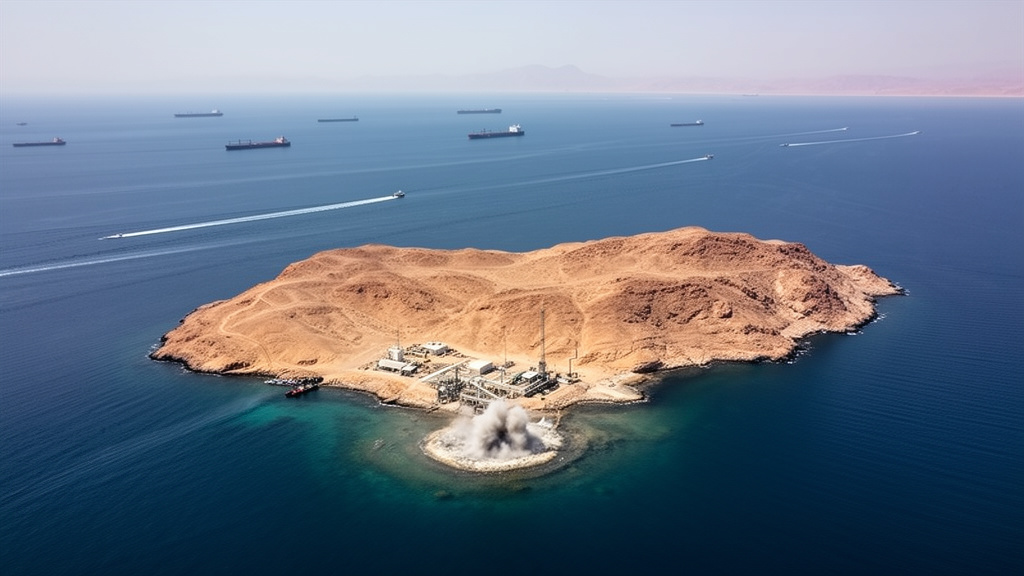
The U.S. military has executed a precision strike against two Iranian rocket launchers located at Larak Island in the Strait of Hormuz, a critical maritime chokepoint that serves as a vital artery for global energy markets. This operation marks the first time U.S. forces have engaged in kinetic action against Iranian assets since July, signaling a potential shift in the rules of engagement and the Pentagon’s threshold for regional provocations. The strikes were reportedly calibrated to neutralize immediate threats to international shipping lanes without escalating into a wider regional conflict.
Key Highlights
- Strategic Location: The rocket launchers were positioned on Larak Island, a key vantage point overlooking the narrow Strait of Hormuz.
- First Engagement Since July: This event breaks the relative kinetic stalemate observed between the two nations since the previous incident in mid-summer.
- Maritime Security Priority: The Strait of Hormuz is responsible for the transit of approximately 20-30% of the world’s total oil consumption, making the protection of these waters a top-tier U.S. national security concern.
- Calculated Deterrence: The strikes were described as limited and targeted, aimed specifically at neutralizing the threat to vessels rather than a broader offensive campaign.
Strategic Recalibration: Analyzing the Larak Island Operation
The decision to strike assets on Larak Island is far from a routine military maneuver; it represents a deliberate recalibration of U.S. defensive posture in the Persian Gulf. For months, the U.S. has adhered to a policy of containment, attempting to manage regional friction through surveillance and increased naval presence. However, the discovery and subsequent targeting of these rocket launchers suggest that the Department of Defense (DoD) identified a clear, imminent danger to commercial maritime traffic that necessitated a departure from the status quo.
The Tactical Context of the Strait of Hormuz
The Strait of Hormuz is one of the world’s most precarious maritime choke points. Its narrow width creates a scenario where any anti-ship capability stationed on islands like Larak or in nearby coastal facilities poses a disproportionate threat to global commerce. By stationing rocket launchers on Larak Island, forces were effectively creating a ‘denial zone.’ The U.S. Central Command (CENTCOM) clearly assessed that these specific launchers were being prepared or were already in a position to threaten transiting tankers or U.S. naval vessels. The strike was likely carried out using precision-guided munitions to minimize collateral impact while ensuring the total degradation of the launchers’ capabilities.
Breaking the Kinetic Stasis
Following the events of July, there was a quiet, albeit tenuous, understanding between Washington and Tehran regarding the limits of provocation. For the past several months, the U.S. had largely relied on diplomatic pressure and show-of-force deterrents—such as the rotation of carrier strike groups and the deployment of advanced surveillance assets—to keep the peace. The fact that the U.S. resorted to kinetic force now implies that those non-kinetic deterrents were perceived as insufficient. This escalation forces analysts to reconsider the stability of the entire region. If the threshold for U.S. intervention has lowered, Tehran may be forced to recalculate its own strategies for coastal defense and regional influence.
The Energy and Economic Implications
Beyond the military hardware and the geopolitical posturing, the global economy remains the silent stakeholder in these developments. The Strait of Hormuz is the world’s most important oil transit chokepoint. Market volatility is often tied directly to the frequency and intensity of activity in this corridor. While the strike was localized, the broader market perception of increased risk can lead to insurance premium hikes for commercial shipping, which subsequently translates to higher energy costs for consumers globally. Investors are watching closely to see if this incident remains an isolated event or the beginning of a sustained period of tactical volatility in the Persian Gulf.
The Future of Regional Deterrence
The U.S. military’s reliance on ‘precision over presence’ appears to be the current doctrine. Rather than maintaining a permanent, all-encompassing blockade—which would be logistically exhausting—the Pentagon is choosing to maintain a ‘snap-action’ capability. This approach requires elite intelligence gathering to identify threats in real-time. The success of this operation on Larak Island proves that the U.S. intelligence apparatus continues to monitor the Iranian coastline with extreme precision. Moving forward, the effectiveness of this policy will depend on whether Tehran chooses to de-escalate or tests this new, firmer American line with further provocations of their own.
FAQ: People Also Ask
Q: Why was Larak Island chosen for the strikes?
A: Larak Island is strategically situated at the entrance of the Strait of Hormuz. Because of its geography, weapons platforms placed there can easily target vessels transiting the main shipping channels, making it a high-priority location for regional security monitoring.
Q: Does this mean the U.S. is going to war with Iran?
A: Military officials characterize these strikes as ‘limited and targeted,’ intended to neutralize an immediate threat rather than initiate an offensive war. This is a tactical engagement meant to deter further aggression, not a declaration of full-scale conflict.
Q: How does this impact oil prices?
A: Because the Strait of Hormuz handles roughly 20-30% of global oil shipments, any military action in the area often leads to short-term market uncertainty, which can cause oil prices to fluctuate based on fears of supply chain disruption.
Q: When was the last time the U.S. struck Iran before this?
A: Prior to this operation, the last recorded kinetic U.S. strike against Iranian-linked assets or in this specific theatre of conflict occurred in July of this year.