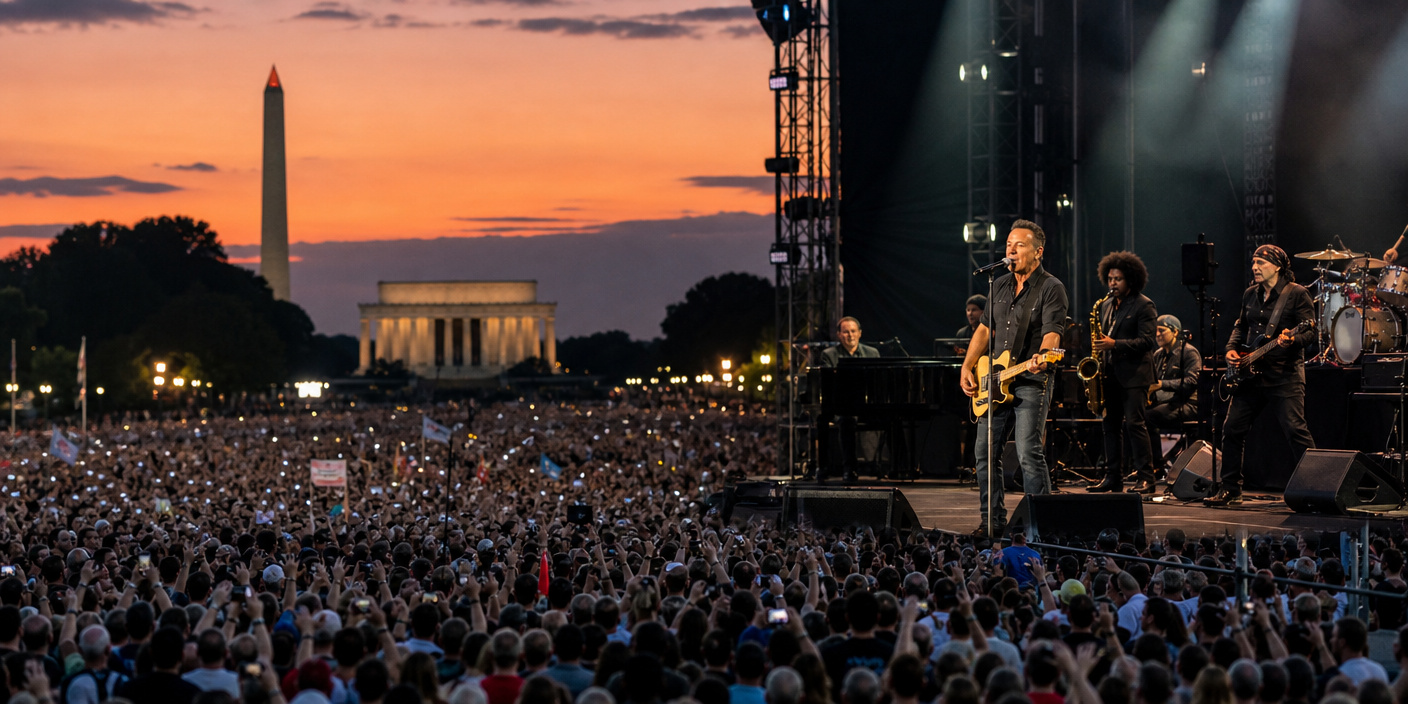
On October 4, 2026, the heart of the American capital became the epicenter of a musical and cultural phenomenon. Bruce Springsteen, the architect of the working-class American myth, took to the main stage at Washington D.C.’s inaugural ‘Power to the People’ festival. This wasn’t merely a concert; it was a massive cultural event that drew hundreds of thousands to the National Mall, transforming the seat of government into a sprawling, acoustic expanse of solidarity and song. The atmosphere was charged with a palpable tension that eventually gave way to the cathartic, driving rhythms synonymous with the E Street Band’s four-decade legacy.
The Resonance of the National Mall
Hosting an artist of Springsteen’s magnitude on the National Mall is a logistical undertaking that few manage with grace. The decision to place the ‘Power to the People’ festival at this specific coordinate was not incidental. The Mall, traditionally a space for political protest, presidential inaugurations, and civic remembrance, served as the ultimate canvas for a musician whose lyrics have historically wrestled with the promise and failure of the American Dream.
As the sun dipped below the horizon on October 4, the silhouettes of the Washington Monument and the Lincoln Memorial framed the stage, creating a natural amphitheater of profound weight. Springsteen, ever the student of American history, seemed to recognize the gravitas of the venue. From the opening chords, the crowd was not just an audience; they were a congregation. The sheer scale of the event highlighted a resurgence in the desire for communal musical experiences that carry a message of unity. In a landscape often fragmented by digital silos, the physical gathering of such a diverse demographic—spanning generations from the baby boomers who saw him in the 70s to Gen Z listeners drawn to the timeless nature of his songwriting—was a testament to the enduring power of rock and roll as a unifying civic language.
Setlist Analysis: Curating the American Narrative
Springsteen’s setlist for the ‘Power to the People’ festival was a masterclass in narrative pacing, carefully curated to reflect the event’s theme. Moving away from a standard greatest-hits run, he leaned heavily into the catalog that addresses labor, aspiration, and the grit of everyday life. The opening number, a high-octane rendition of “The Promised Land,” felt like a manifesto for the evening. By the time the band pivoted into the somber, reflective tones of tracks from the Nebraska era, the crowd’s energy shifted from ecstatic celebration to focused, intentional listening.
The inclusion of socially conscious anthems—songs that have historically soundtracked American political movements—underscored the festival’s moniker. It was a conscious effort to reclaim the concept of “Power to the People” as an inclusive, non-partisan call for shared progress. The pacing was intentional: moments of full-throttle rock intensity were interspersed with stripped-back, acoustic segments that forced the audience to reckon with the lyrics. This wasn’t just entertainment; it was a curated journey through the American condition, delivered by a performer who has spent his career refining this specific craft.
The Civic Pulse: Why Springsteen in 2026?
Why does Bruce Springsteen still matter in the cultural discourse of 2026? The ‘Power to the People’ festival organizers explicitly stated that they sought an artist whose integrity and history of public service matched the festival’s ambitions. Springsteen’s career has been marked by a consistent advocacy for veterans, labor unions, and local community revitalization.
In the current climate, where the concept of civic engagement is constantly being reshaped by technological influence and shifting political tides, Springsteen represents a bridge to a more tangible form of activism. He does not simply perform; he represents a continuity of voice. By headlining this specific event, he validated the festival’s mission, drawing attention to its goals of fostering dialogue and community investment. Critics and fans alike noted that his performance felt less like a promotional stop and more like a necessary act of public expression. He effectively bridged the gap between the music industry’s commercial demands and the socio-political realities of the day, proving that at age 77, his capacity to command a narrative remains undiminished.
Economic and Logistical Footprint
Beyond the art, the economic impact of the festival on the District of Columbia cannot be understated. Washington D.C. officials reported that the influx of visitors for the October 4 event rivaled the attendance numbers of major national holidays. The hospitality, retail, and transit sectors saw a localized surge that serves as a case study for the value of large-scale cultural programming in urban centers.
The logistics of the 2026 festival—coordinating security, sound engineering for an open-air venue of this size, and city-wide traffic management—presented a complex operational puzzle. The success of the ‘Power to the People’ festival in executing this event without major incident is being cited by event planners as a gold standard for future large-scale gatherings. As cities continue to compete for tourism and cultural capital, the ability to anchor a festival with an artist of Springsteen’s caliber has proven to be the most effective strategy for regional economic stimulation.
Ultimately, the night was defined by the singular interaction between an artist, his band, and a city eager to be moved. As the final notes of the encore echoed across the reflecting pool, the significance of the moment was clear: the ‘Power to the People’ festival had successfully established itself as a cornerstone of the American cultural calendar, with Bruce Springsteen firmly cementing his role as its inaugural guiding light.
FAQ: People Also Ask
Q: Was the ‘Power to the People’ festival a political event?
A: While the festival focused on themes of civic engagement, community, and social history, the organizers and Springsteen maintained that the event was rooted in universal values of unity and participation rather than partisan political advocacy.
Q: How many people attended the Springsteen set in D.C.?
A: Official city reports estimated attendance on the National Mall for the duration of the festival, with Springsteen’s headline set reaching peak capacity, cementing it as one of the largest concert gatherings in the city for 2026.
Q: Will the ‘Power to the People’ festival return in 2027?
A: Following the massive success of the October 4, 2026 event, organizers have signaled strong intent to continue the festival as an annual tradition, though no official dates or headliners for 2027 have been confirmed.
Q: What was the significance of the setlist choices?
A: Springsteen curated a setlist specifically to align with the ‘Power to the People’ theme, focusing on songs that emphasize labor, resilience, and the American experience, rather than a standard commercial greatest-hits performance.