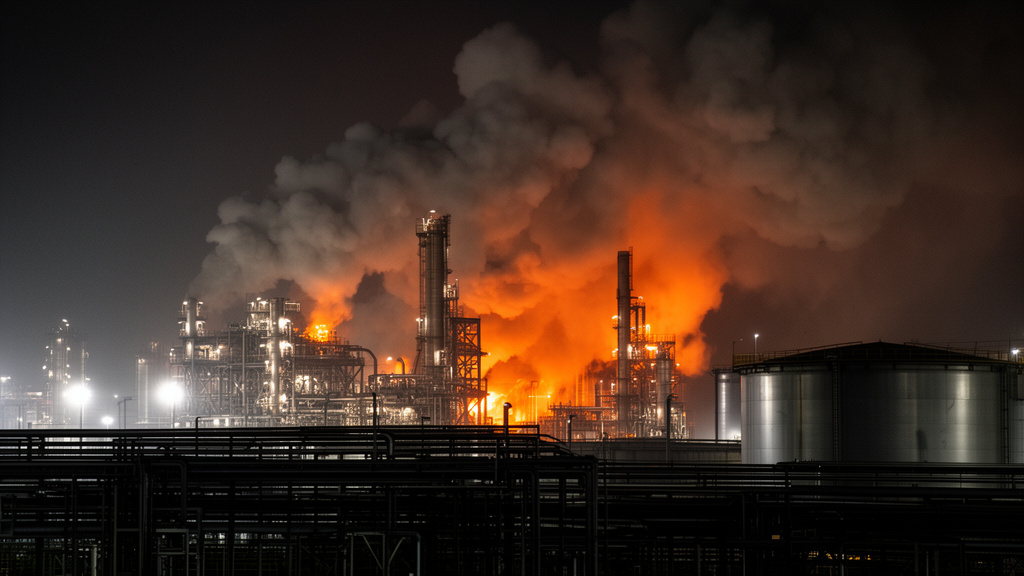
In a seismic shift to the conflict’s aerial campaign, Ukrainian forces successfully executed a large-scale drone attack on Moscow Oblast, deploying a unprecedented wave of over 1,600 long-range unmanned aerial vehicles. The saturation strike penetrated deep-state defenses, triggering a massive, visible blaze at the Moscow Refinery—a critical node in Russia’s energy infrastructure—and resulting in confirmed civilian casualties. This operation marks a significant departure from previous skirmishes, highlighting the evolution of drone swarm technology and a new strategic reality in the war.
Key Highlights
- Unprecedented Scale: The operation involved a staggering 1,600 long-range drones, designed to saturate and overwhelm integrated air defense systems.
- Critical Infrastructure Hit: A significant fire broke out at the Moscow Refinery, potentially disrupting regional energy supplies and refining capabilities.
- Human Impact: Local authorities have confirmed civilian casualties resulting from both the direct impact and the resulting debris from air defense interceptions.
- Strategic Escalation: This strike demonstrates Ukraine’s capability to project power into the Russian capital’s heartland, challenging the perceived security of the Moscow Oblast.
The Anatomy of an Unprecedented Aerial Assault
The operation, which analysts are already describing as a tactical turning point, utilized a swarm tactic of unprecedented magnitude. By deploying 1,600 long-range drones, Ukrainian forces forced a defensive collapse through sheer volume, as Russia’s air defense systems were reportedly saturated by the simultaneous arrival of multiple vectors. The primary target, the Moscow Refinery—owned by Gazprom Neft—is one of the largest and most vital refining facilities in the region, responsible for a significant percentage of fuel production for the Moscow metropolitan area.
Targeting Infrastructure: The Economic Cost
The choice of the Moscow Refinery as the primary target is highly calculated. Beyond the immediate destruction and the blaze that sent plumes of smoke over the skyline, the attack strikes at the core of the Russian energy economy. Modern refineries are complex, integrated systems; even localized fires in processing units can lead to prolonged shutdowns of entire sections of the plant for repairs. If the damage is extensive, this could create fuel supply chain bottlenecks that ripple outward from the Moscow Oblast, impacting logistics, transport, and heating costs in the coming winter months.
The Shift in Drone Warfare
Historically, drone attacks in the Moscow region were sporadic and conducted with limited numbers. The move to a 1,600-unit swarm indicates a sophisticated shift in Ukrainian military doctrine. By utilizing high-volume, low-cost UAVs, Ukraine is effectively changing the economics of air defense. The cost to intercept a single low-cost drone with an advanced missile system is drastically higher than the drone itself. When that equation is multiplied by over a thousand, the defensive strategy becomes unsustainable, forcing the Kremlin to rethink how it protects deep-state assets against asymmetric warfare.
Civilian Consequences and Regional Panic
While the primary targets were industrial, the sheer density of the drone swarm meant that interceptions occurred over populated areas. The resulting falling debris and secondary explosions caused confirmed civilian casualties, marking a grim escalation in the war’s expansion into civilian environments. The psychological impact on the residents of the Moscow Oblast is significant, as the previous sense of insulation from the conflict has been abruptly dismantled.
Future Implications: A New Era of Deep-State Targeting
Looking ahead, this event raises three critical secondary questions for the trajectory of the war:
1. The Sustainability of Swarm Tactics: Can the Ukrainian military industrial complex maintain this volume of production and deployment, or was this a singular, resource-intensive operation?
2. Russian Defensive Adaptation: Will Moscow move toward a more static, localized air defense architecture around critical energy sites, or will the costs of total protection prove too high to bear?
3. Diplomatic and Escalation Thresholds: How will this attack influence the ongoing international rhetoric regarding the use of long-range weapons? By demonstrating an indigenous capability to strike at this scale, Ukraine has effectively altered its leverage in security negotiations.
FAQ: People Also Ask
Q: How did 1,600 drones bypass Russian air defenses?
A: The massive scale of the attack appears to have saturated the defensive network. When an air defense system is overwhelmed by a volume of targets that exceeds its tracking and interceptor capacity, gaps inevitably open, allowing a percentage of the drones to reach their target coordinates.
Q: What is the significance of the Moscow Refinery?
A: The Moscow Refinery is a major industrial hub for oil processing and fuel distribution in the Moscow region. It is essential for the region’s energy self-sufficiency, and significant damage here can lead to immediate local fuel supply shortages.
Q: Are there confirmed civilian casualties?
A: Yes, local reports confirm civilian casualties resulting from the attack, attributed to both direct impacts and the hazards posed by falling debris from intercepted drones over residential areas.
Q: Does this signal a broader change in the conflict?
A: Many analysts believe this demonstrates a shift toward more aggressive targeting of Russian industrial and economic infrastructure, moving the conflict from the frontlines directly into the Russian interior.