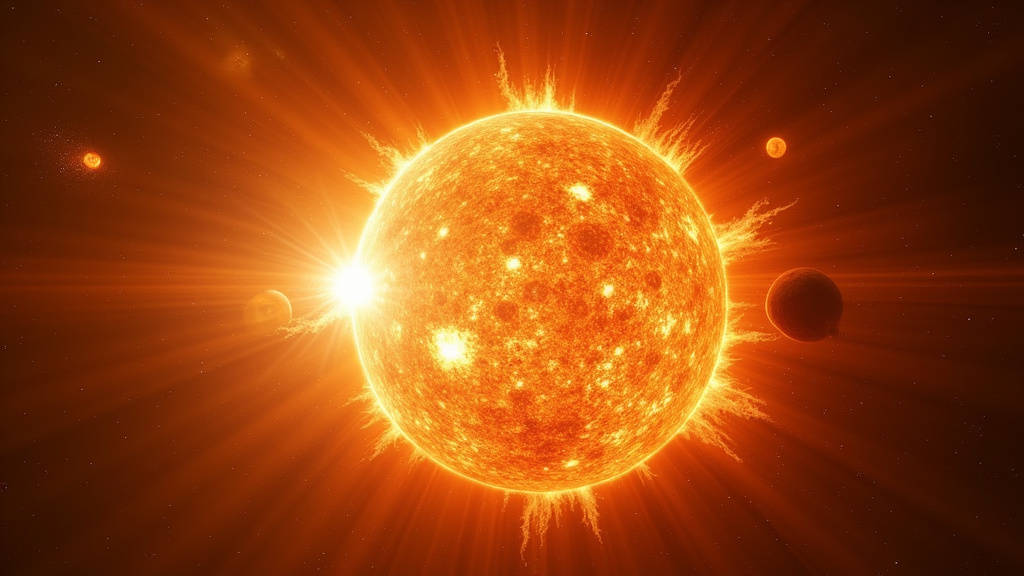
In a groundbreaking observation that offers a direct glimpse into the volatile youth of our own solar system, astronomers have successfully captured a colossal, multi-temperature plasma eruption from a young Sun-like star, a remarkable Stellar Eruption Event. This dramatic event, known as a coronal mass ejection (CME), from the star EK Draconis, provides critical insights into how such powerful stellar outbursts could have shaped early planets, influenced their atmospheres, and potentially paved the way for life’s emergence on Earth.
Cosmic Tantrums and Stellar Eruption Events
Our Sun, while relatively stable today, was a far more tempestuous entity in its infancy billions of years ago. Scientists believe that during its early stages, the Sun frequently unleashed massive coronal mass ejections (CMEs)—colossal bursts of plasma and magnetic field—that were significantly more powerful and energetic than those observed in modern times. These cosmic tantrums, often part of a significant Stellar Eruption Event, are thought to have played a pivotal role in shaping the early solar system, potentially stripping atmospheres from planets like Mars and Venus, while simultaneously creating conditions that could foster life on Earth.
Until recently, directly observing these ancient stellar outbursts, especially their energetic, high-velocity components, has been a significant challenge. While cooler plasma fragments of CMEs have been detected, capturing the full, multi-temperature profile of these violent events from young stars has remained elusive. This new research, however, marks a significant leap forward in this endeavor of studying a Stellar Eruption Event.
Capturing the Violent Stellar Eruption in Detail
An international team of astronomers, led by Kosuke Namekata of Kyoto University and involving researchers from Japan, Korea, and the United States, utilized a coordinated campaign employing both the NASA/ESA Hubble Space Telescope and ground-based observatories. This dual approach allowed them to simultaneously observe EK Draconis, a star approximately 111 light-years away in the constellation Draco, which serves as a prime analogue for our Sun’s early years (estimated age of 50-125 million years). This observation of a Stellar Eruption Event from EK Draconis star is highly significant.
Hubble’s ultraviolet observations were sensitive to hot plasma, while ground-based telescopes tracked cooler gases using hydrogen-alpha emissions. This precise, multi-wavelength spectroscopic analysis enabled the team to witness a CME composed of distinct temperature components in real time. The observations revealed a two-phase eruption: an initial blast of extremely hot plasma, reaching temperatures of 100,000 Kelvin, ejected at speeds between 300 to 550 kilometers per second. This was followed approximately ten minutes later by a wave of cooler gas, around 10,000 Kelvin, moving at a slower pace of 70 kilometers per second. This multi-temperature structure is a key finding of this Stellar Eruption Event, demonstrating that young, sun-like stars produce CMEs similar in composition to our own Sun’s, but with vastly greater energy.
Implications for Planetary Evolution and the Dawn of Life from a Stellar Eruption Event
The energetic particles and shocks generated by such powerful CMEs are believed to have had profound effects on early planetary environments. The high kinetic energy carried by the hot plasma component suggests these events could have been potent enough to erode planetary atmospheres or drive chemical reactions crucial for the emergence of life, impacting planetary evolution. Scientists posit that these energetic outbursts could have synthesized biomolecules and greenhouse gases essential for warming early planets and supporting primitive life forms, while simultaneously stripping away atmospheres from planets less fortunate than Earth. The study of this Stellar Eruption Event is crucial for understanding the origins of life.
This discovery offers direct evidence supporting long-standing theories about the “Faint Young Sun paradox”—the puzzle of how early Earth could have been warm enough to support liquid water and life when the young Sun was less luminous than it is today. The intense stellar space weather, driven by frequent superflares and CMEs from the nascent Sun during such a Stellar Eruption Event, likely provided the necessary atmospheric chemistry and heat, influencing exoplanet habitability.
A Major Space Event Unveiled for Global Understanding of a Stellar Eruption Event
This observation is more than just a fascinating astronomical event; it is a significant discovery that underscores the dynamic nature of stellar evolution and its impact on planetary habitability. The comprehensive data gathered marks this as a major breakthrough in astrophysics, offering a rare window into the conditions that may have prevailed during the formation of our own solar system during a significant Stellar Eruption Event.
Understanding these space events is crucial for comprehending not only the past but also the potential for life on exoplanets. Such findings, often highlighted in top scientific news, contribute to a broader understanding of major global events that shape cosmic evolution. This research positions itself as a trending topic in astronomy, promising further revelations about our universe through the study of phenomena like a Stellar Eruption Event.
Rewriting Our Solar System’s Turbulent Past through Stellar Eruption Events
By studying stars like EK Draconis, astronomers are essentially peering back in time, reconstructing the intense stellar space weather that characterized the early solar system. The unprecedented detail of this multi-temperature CME observation helps scientists refine models of planetary formation and atmospheric evolution, shedding light on why Earth became a cradle for life while its neighbors followed different paths. The occurrence of a Stellar Eruption Event is key to these processes.
The findings, published in Nature Astronomy, represent a significant achievement in observational astronomy and underscore the importance of international collaboration in pushing the boundaries of scientific knowledge. As researchers continue to study the turbulent youth of stars, we gain deeper insights into the Sun’s own fiery beginnings and the complex cosmic dance that ultimately led to the conditions necessary for life on Earth, all driven by events like the observed Stellar Eruption Event. This allows for a better understanding of a young star CME.