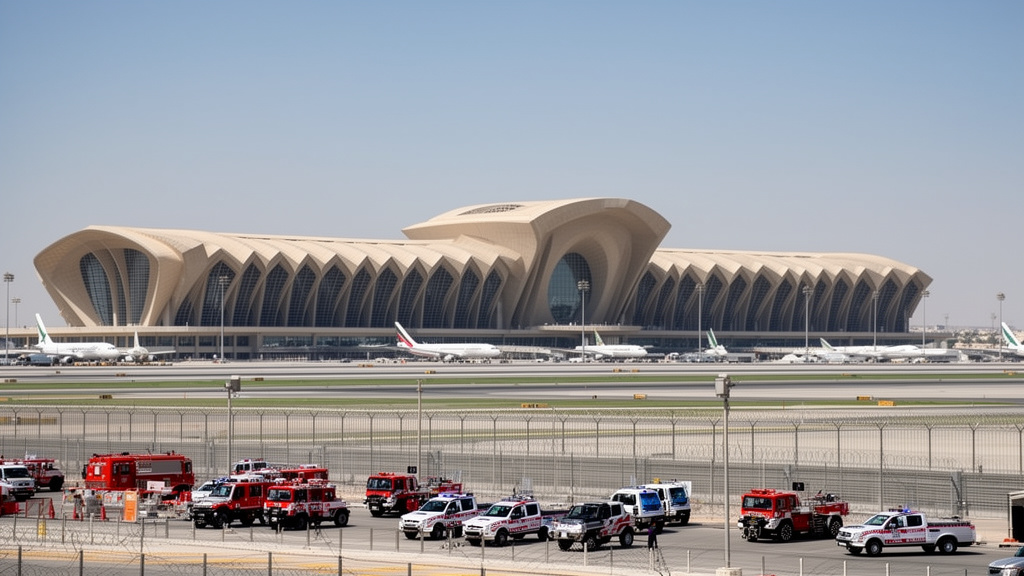
At least 12 people have been confirmed dead and over 300 individuals sustained injuries following a major security incident at Riyadh’s King Khalid International Airport (KKIA). The assault, which struck the facility earlier today, forced the Saudi General Authority of Civil Aviation (GACA) to immediately suspend all incoming and outgoing flights, grounding aircraft and trapping thousands of passengers in a terminal lockdown. Security forces have since cordoned off the area as investigation units work to identify the perpetrators and determine the methodology used to breach one of the Kingdom’s most fortified transport hubs.
Key Highlights
- Mass Casualty Incident: At least 12 confirmed fatalities with medical facilities reporting over 300 injuries, many of which require urgent trauma care.
- Operational Freeze: The General Authority of Civil Aviation (GACA) has officially suspended all flight operations at King Khalid International Airport until further notice.
- Security Lockdown: Massive deployment of security and emergency response teams to the facility; local law enforcement is currently conducting a sweep of all terminals.
- Regional Tensions: The incident occurs against a backdrop of escalating regional volatility, drawing swift concern from international monitoring agencies.
Crisis at the Gateway to Riyadh: Unpacking the Security Breach
The events at King Khalid International Airport (KKIA) represent a significant shift in the regional security landscape. As the primary gateway for the Saudi capital, KKIA is typically defined by rigorous security protocols and multi-layered defense mechanisms. The scale of the attack—resulting in over 300 casualties—suggests a highly coordinated effort that successfully bypassed standard perimeter controls.
Impact on Airport Operations and Global Travel
Following the activation of emergency protocols, the suspension of all air traffic has triggered a massive logistical challenge. As thousands of travelers remain grounded, airlines across the Middle East are scrambling to divert incoming flights to neighboring hubs, including Dammam’s King Fahd International Airport and international airports in the United Arab Emirates.
Logistically, the shutdown of such a critical transit node is expected to have immediate, cascading effects on air cargo and passenger throughput. With supply chains increasingly dependent on air freight, the disruption to KKIA—a key hub for the Saudi Vision 2030 initiatives—could ripple across the regional economy if the closure extends beyond the initial 48-hour period. Industry analysts are now projecting that the restoration of normal flight schedules will require extensive security re-evaluations and potential hardware upgrades to terminal infrastructure.
Geopolitical Ramifications and Regional Stability
Beyond the immediate tactical consequences, this incident is inseparable from the current state of regional geopolitics. Saudi Arabia has been working to position itself as a global travel and commercial nexus; an attack of this magnitude strikes at the heart of that ambition. The Saudi Ministry of Interior has indicated that the investigation is a top priority, with high-level intelligence and counter-terrorism units leading the inquiry.
The international response has been swift. Global leaders are monitoring the situation closely, particularly given the implications for oil market stability and diplomatic relations in the Persian Gulf. Observers are asking whether this event signals a broader pattern of instability or a localized security failure. The resilience of the Saudi security apparatus will be tested in the coming days as the state attempts to regain control of its infrastructure while simultaneously managing domestic public sentiment.
Medical Response and Humanitarian Management
The sheer volume of casualties—over 300 injured—has placed an unprecedented burden on the Riyadh healthcare system. Emergency services deployed rapidly, establishing triage centers on the perimeter of the airport to manage the flow of victims before transporting them to hospitals across the capital.
The coordination between the Saudi Red Crescent, local hospital networks, and military medical corps is being tested as surgeons, blood banks, and critical care units manage the trauma influx. Hospitals in the greater Riyadh metropolitan area have reportedly declared states of emergency to prioritize the care of the wounded, highlighting the sophisticated, albeit strained, disaster management framework established for the city.
Assessing Vulnerability: Future Security Protocols
In the aftermath, the conversation in government circles will inevitably shift toward the hardening of civil infrastructure. King Khalid International Airport, like many global mega-hubs, relies on a combination of biometric surveillance, deep perimeter checks, and intelligence sharing.
If the attackers were able to circumvent these layers, a comprehensive audit of the entire security architecture—from baggage handling to public access points—is likely to follow. Security experts suggest that future protocols will likely include the implementation of ‘buffer zone’ checkpoints further away from the terminal entrance and an increase in armed air marshals and surveillance drones patrolling the airport’s vast exterior. The goal will be to restore public confidence in the safety of air travel within the Kingdom, which remains the backbone of international tourism and business investment in the region.
FAQ: People Also Ask
1. Are flights currently operating at King Khalid International Airport?
No. As per official mandates from the Saudi General Authority of Civil Aviation (GACA), all operations are currently suspended. Passengers are advised to contact their airlines for specific information regarding cancellations and rebooking.
2. What is the current casualty count?
As of the latest reports, there are at least 12 confirmed deaths and over 300 individuals suffering from injuries resulting from the attack.
3. Is it safe to travel to Riyadh currently?
Travelers are urged to monitor official government travel advisories. Following this major incident, local authorities are maintaining a heightened security presence, and non-essential travel to the area surrounding the airport should be avoided until the situation is stabilized.
4. What is the cause of the attack?
The exact methodology and perpetrators remain under investigation by the Saudi Ministry of Interior. Authorities have pledged a thorough review to determine how the security perimeter was compromised.