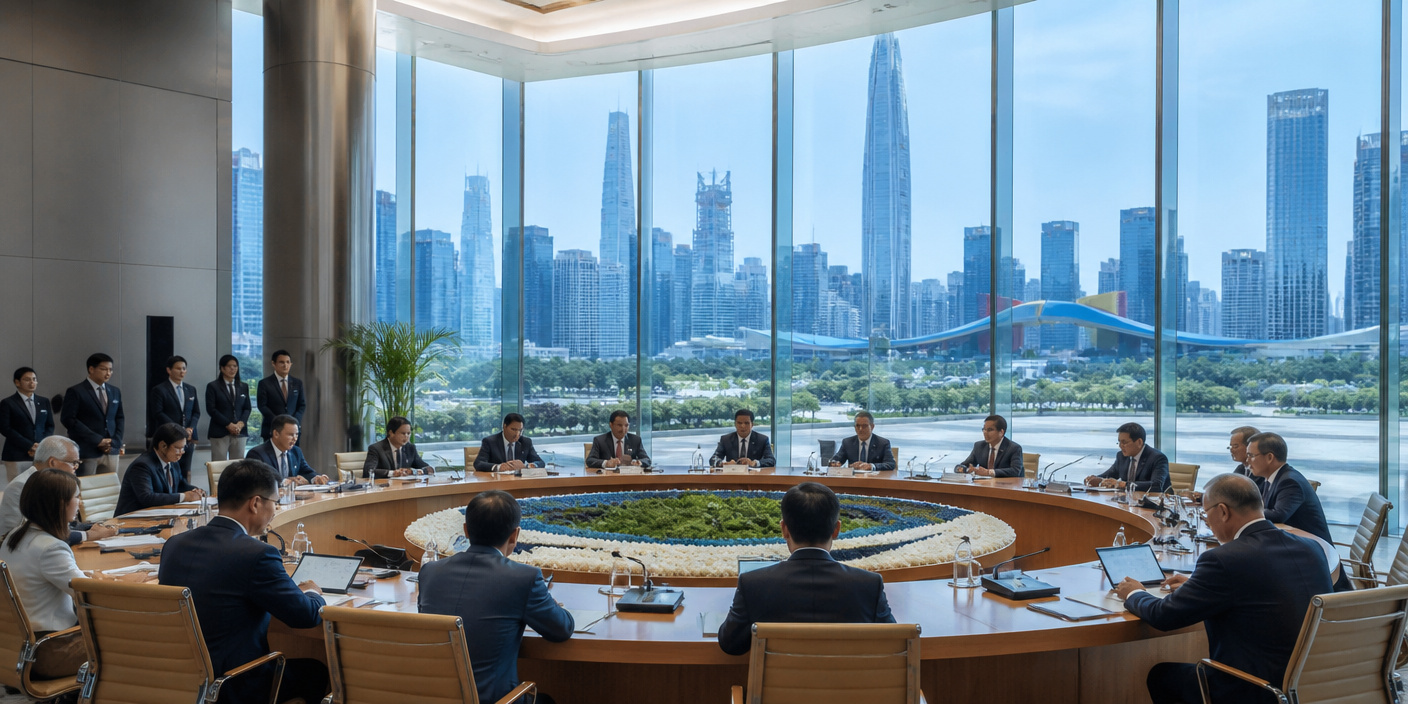
The 33rd APEC Leaders’ Meeting, scheduled for November 18-19, 2026, in Shenzhen, China, stands as the most consequential diplomatic gathering of the decade. As President Trump, President Xi Jinping, and President Vladimir Putin converge in the heart of China’s technological engine, the world watches to see if this summit will serve as a mechanism for de-escalation or a stage for entrenched geopolitical posturing. With the global economy navigating a fractured post-pandemic recovery and shifting alliances, the discussions in Shenzhen are expected to center on the future of Pacific Rim trade frameworks and critical security architecture.
Key Highlights
- Historic Summit Dates: The 33rd APEC Leaders’ Meeting will officially convene on November 18-19, 2026, hosted in the major economic hub of Shenzhen, China.
- High-Stakes Agenda: Central discussions will revolve around the potential interaction between President Trump, President Xi Jinping, and President Vladimir Putin, focusing heavily on trade tariffs and Pacific security cooperation.
- Economic Volatility: Analysts anticipate that the meeting will attempt to address the widening rift in international trade standards, with specific attention paid to the influence of the World Trade Organization (WTO) and regional trade agreements.
- Security Realignment: Beyond economics, the summit serves as a crucial backdrop for reassessing regional security treaties and defense policies across the Pacific corridor.
The Shenzhen Summit: A New Geopolitical Chessboard
The selection of Shenzhen as the host city for the 2026 APEC summit is no coincidence. As the epicenter of China’s Special Economic Zones and a global nexus for hardware manufacturing and tech innovation, Shenzhen represents the very stakes of the current trade discourse. When President Trump, President Xi, and President Vladimir Putin meet, they do so not merely as heads of state, but as representatives of competing economic visions.
The Trade War Redux
At the forefront of the agenda is the recalibration of trans-Pacific trade. Following years of volatility, the economic departments within the White House and the Kremlin, along with Beijing’s trade authorities, have signaled that the status quo is untenable. For the U.S. administration, the focus remains on domestic manufacturing parity and the enforcement of reciprocal trade agreements. Meanwhile, Beijing is expected to champion its ‘Dual Circulation’ strategy, aimed at bolstering domestic consumption while maintaining export dominance. The tension between these approaches will likely dominate the summit’s closed-door sessions, where the efficacy of existing WTO mandates will be scrutinized.
Security Architecture and The Pacific Rim
Security in the Pacific is perhaps the most delicate item on the agenda. The meeting comes at a time when traditional alliance structures—such as the various bilateral defense treaties involving the United States—are being tested by emerging partnerships between Moscow and Beijing. Security analysts at the event are bracing for discussions regarding maritime sovereignty and the proliferation of trade routes. The goal for many APEC member nations is to insulate regional trade from the spillover effects of security competition. However, given the presence of all three major powers, the reality of ‘security-linked trade’ will likely prove difficult to avoid.
Why Shenzhen Matters
The venue itself is a symbol. By hosting the summit in Shenzhen, Beijing is showcasing its pivot toward high-tech industrial dominance. For the U.S. and other Western delegations, navigating this space is a reminder of the shifting leverage in global supply chains. The discussions will inevitably touch upon technological sovereignty—who controls the microchips, the AI infrastructure, and the rare earth minerals that power the global economy. This is not just a diplomatic summit; it is an assessment of which nation holds the superior economic foundation as the world enters the late 2020s.
Secondary Angles: Examining the Fallout
1. The Supply Chain Resilience Factor: Beyond the headlines of presidential handshakes, the meeting will likely drive secret-track negotiations regarding the future of global supply chains. Expect member nations to push for diversification agreements that minimize the risk of single-point-of-failure scenarios in critical industries.
2. Energy Independence and Climate Policy: While trade dominates, the intersection of energy markets and climate mandates will likely form a ‘hidden’ agenda. As these nations discuss economic growth, the necessity of securing affordable energy sources—and the geopolitical strings attached to them—will be a primary driver of private conversations.
3. The Role of the ‘Middle Powers’: Nations like Vietnam, Indonesia, and Australia will be acting as crucial swing states. The strategic maneuvering of these APEC members to avoid being forced to choose sides in a U.S.-China-Russia rivalry will be one of the most under-reported but vital aspects of the summit.
FAQ: People Also Ask
Q: Why is the APEC summit being held in Shenzhen in 2026?
A: Shenzhen was selected as the host city to underscore its status as a premier global technological and economic hub, providing a symbolic backdrop for discussions regarding the future of global trade, innovation, and infrastructure.
Q: What are the primary concerns regarding Trump, Xi, and Putin interacting?
A: The primary concern is the potential for diplomatic gridlock. Given the starkly different approaches to trade policy, human rights, and regional security held by the U.S., China, and Russia, the international community is anxious about the potential for escalating rhetoric versus substantive progress.
Q: How will this summit impact global markets?
A: Markets are expected to react to the ‘signals’ sent during the summit. Any definitive agreements—or breakdowns—regarding trade tariffs or security alliances will likely cause immediate volatility in equities and currency markets, particularly in the tech and defense sectors.