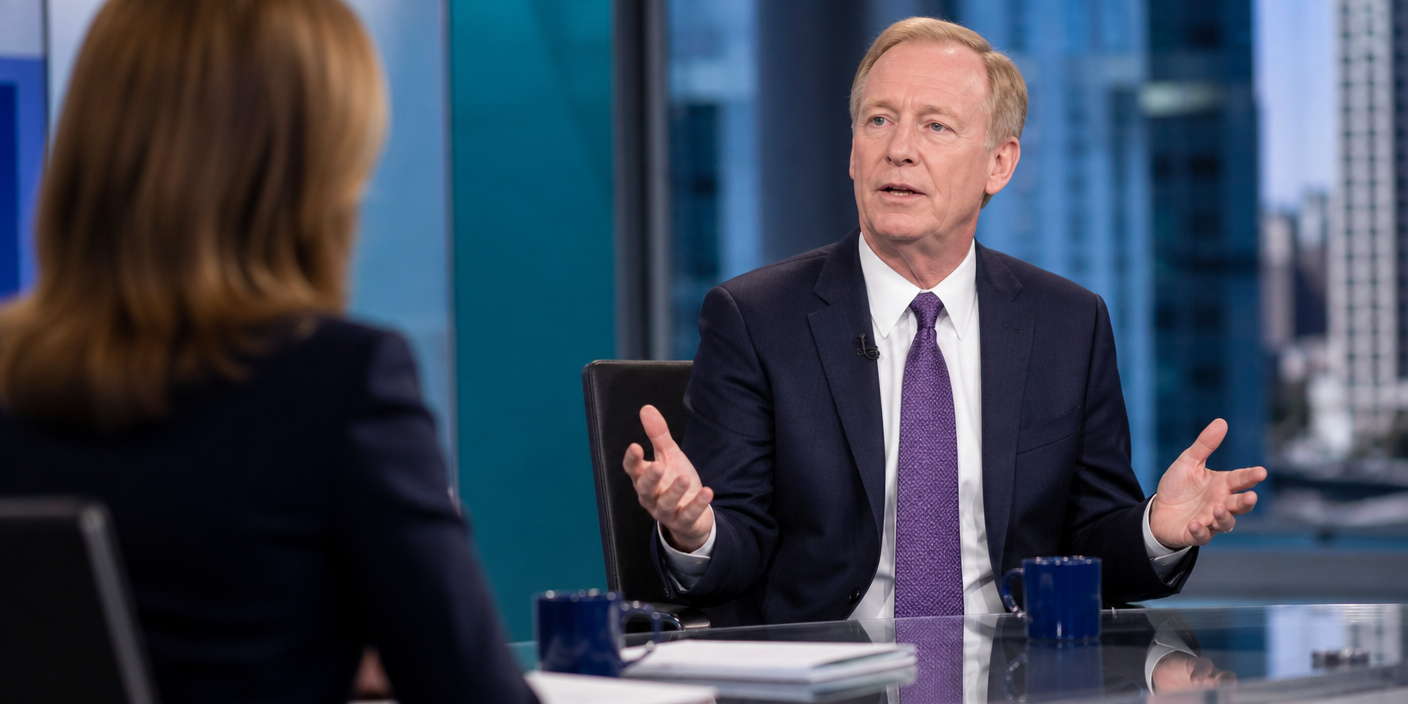
In a candid post-mortem following the recent global infrastructure disruption, Microsoft President and Vice Chair Brad Smith appeared on CBS’s “Face the Nation” this Sunday, November 22, 2026, to provide a definitive account of the instability that paralyzed corporate and government sectors. Smith definitively categorized the event as a technological confluence—a “perfect storm” rather than a malicious act, effectively silencing weeks of speculation regarding cyberwarfare or runaway artificial intelligence.
Key Highlights
- Root Cause Identified: The instability was triggered by the convergence of a four-month-old legacy software update colliding with a recent network modification.
- Not an Attack: Smith explicitly confirmed that the outage was not the result of a cyberattack or an AI-driven failure, dismissing widespread conspiracy theories.
- The ‘Perfect Storm’: The combination of stagnant software and fluctuating network traffic created an unforeseen vulnerability that bypassed standard testing protocols.
- New Safeguards: Microsoft is implementing rigorous, multi-layered technical safeguards to ensure such integration errors cannot cascade through global systems in the future.
Deciphering the Digital Breakdown
The Mechanics of Failure: A Legacy Interaction
During his exchange with Margaret Brennan, Brad Smith offered a rare look into the intricate ecosystem of global cloud infrastructure. At the heart of the crisis was not a singular malicious command, but a complex, multi-variable synchronization error. Smith explained that a critical piece of code—deployed four months prior—had remained dormant and stable under normal operating conditions. However, the introduction of a more recent system update, when compounded by unexpected shifts in global network traffic, acted as a catalyst for failure.
“What we saw was not a breach of perimeter, but a breach of process,” Smith noted. The legacy software, which had performed reliably for 120 days, essentially failed to recognize the handshake protocol of the new update. This misalignment, while minor in isolation, created a ripple effect. Because the architecture was integrated with such high density, the error did not remain localized; it propagated across the network, leading to the outages observed by corporate and government entities worldwide. The incident highlights the inherent fragility of modern, hyper-connected digital infrastructure, where software updates—intended to improve security and performance—can inadvertently introduce instability when layered upon legacy frameworks.
Dispelling the ‘Cyberattack’ Narrative
In the immediate wake of the blackout, cybersecurity analysts and geopolitical observers raised alarm bells, suggesting the possibility of a nation-state actor or a sophisticated ransomware payload. Smith was unequivocal in his rebuttal, providing transparency that Microsoft hopes will restore market confidence. He underscored that telemetry data across all affected nodes showed zero indicators of compromise, unauthorized access, or abnormal exfiltration patterns.
Furthermore, Smith addressed the mounting anxiety regarding Artificial Intelligence. With the increasing reliance on AI-driven load balancing, some speculated that an algorithmic “hallucination” or an autonomous optimization error might have caused the system to crash. Smith clarified that while AI is an integral part of Microsoft’s infrastructure management, the failure was purely a logic error within the core operating layer—a human-architected configuration failure that predated the involvement of any autonomous decision-making agents. By decoupling the event from the “AI panic” narrative, Smith aimed to reassure regulators and the public that the core foundation of the digital economy remains structurally sound, even if the deployment process requires immediate, rigorous reform.
Building the Future: Microsoft’s Pivot to Resilience
Looking forward, the conversation shifted to the long-term implications for Microsoft and the broader tech sector. Smith acknowledged that the status quo for software deployment velocity—often prioritizing speed and agility—must now be balanced with a new philosophy of “resilient stability.” He announced that the company is overhauling its deployment testing environment. This includes the implementation of a “virtual twin” sandbox, where updates will be stress-tested against historical snapshots of legacy configurations before being pushed to live production environments.
Moreover, the company is committing to greater transparency in its update reporting. For organizations relying on Microsoft’s backbone, this means a more detailed “bill of materials” for every update, allowing IT departments to better understand what legacy protocols are being touched or modified. This move, while potentially slowing down update cycles, is seen as a necessary trade-off to protect the mission-critical infrastructure of government and global corporate entities. Smith’s appearance served as a acknowledgment that as tech giants move from serving consumers to underpinning the very structure of modern civilization, their internal processes must be subject to the same level of scrutiny and accountability as critical infrastructure providers like power grids or public utilities.
FAQ: People Also Ask
Q: Was this outage caused by an AI error?
A: No. Brad Smith explicitly stated that the failure was a logical conflict between a legacy software update and a recent change, rather than an autonomous decision or ‘hallucination’ by an AI system.
Q: Why did the outage take so long to resolve?
A: The cascading nature of the failure, caused by the interaction of old code and new updates, required a manual verification process at multiple network nodes to ensure that the fix did not cause further secondary issues.
Q: Is my data safe after this event?
A: Yes. Microsoft’s investigation confirmed that the outage was a functional failure, not a security breach. No data was accessed, stolen, or corrupted during the instability.
Q: Will Microsoft change how it releases updates?
A: Yes, Brad Smith confirmed that the company is adopting new ‘resilient stability’ protocols, including more rigorous sandbox testing against historical system snapshots to prevent similar conflicts in the future.