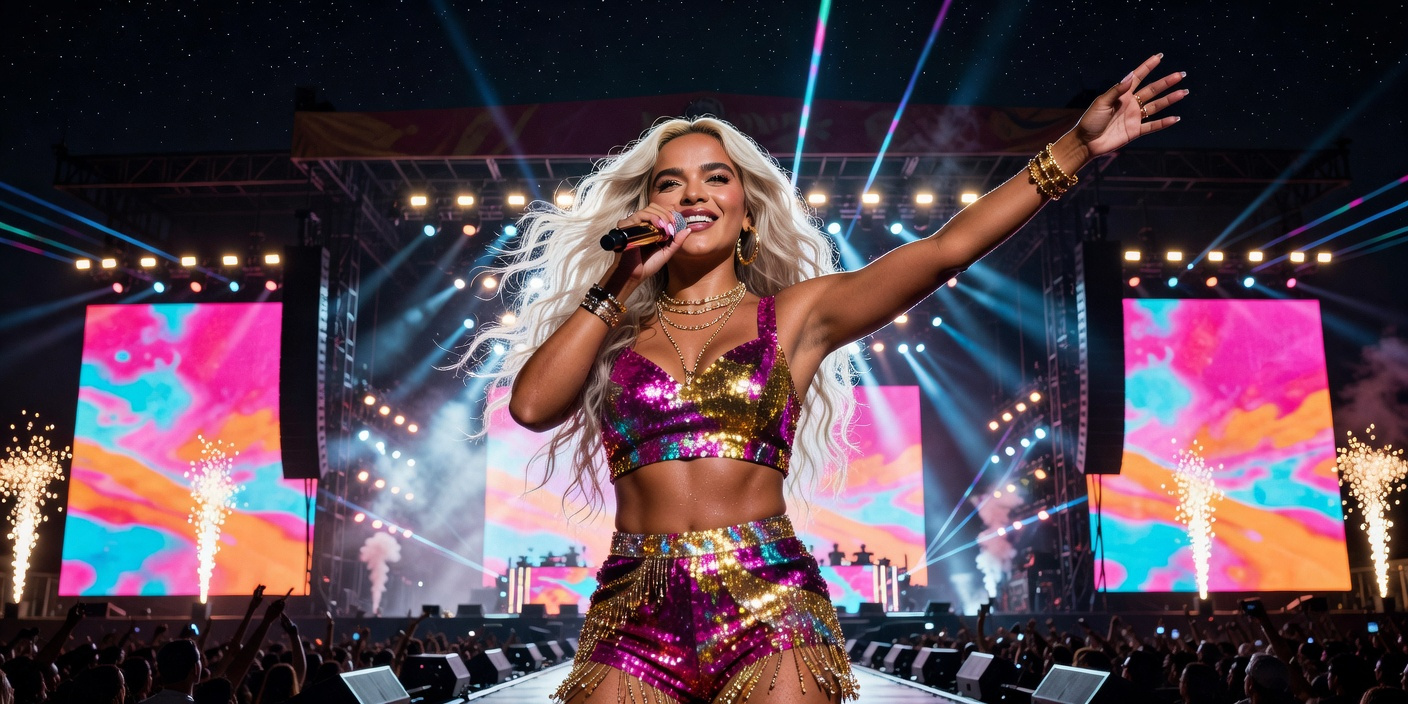
In a defining moment for the evolution of global music festivals, Colombian superstar Karol G took to the main stage at Coachella 2026 on Sunday night, etching her name in history as the first Latina artist to ever headline the iconic event. Her performance was more than just a setlist of hits; it was a powerful statement on the shifting landscape of popular music, demanding space for Latin culture and asserting the dominance of Spanish-language artistry on the global stage. Under the Indio sky, the Medellín native commanded the Empire Polo Club with a production that was as intimate in its delivery as it was grand in its execution, signaling a new era for one of the world’s most prestigious music gatherings.
Key Highlights
- Historic Milestone: Karol G became the first Latina artist to headline Coachella, marking a significant step forward for diversity at the 25-year-old festival.
- The Setlist: The two-hour performance blended reggaeton, Latin pop, and traditional rhythms, featuring live renditions of her chart-topping tracks like “TQG,” “Provenza,” and “Bichota.”
- The Critique: Addressing the crowd, the artist noted the significance of the achievement while acknowledging that it felt “late” for a festival with such a storied history to finally feature a Latina headliner.
- Cultural Impact: Beyond the music, the set utilized high-concept stage design and visual storytelling to highlight the themes of resilience, unity, and Latin heritage.
A Watershed Moment for Latin Music at Coachella
The 2026 Coachella Valley Music and Arts Festival will be remembered not for its logistical advancements or its status as an influencer hub, but for the seismic shift that occurred on its final night. When Karol G stepped onto the main stage, the atmosphere was thick with anticipation. The moment represented the culmination of years of momentum for Latin music, which has steadily climbed from regional interest to global ubiquity.
The Performance: A Two-Hour Sonic Journey
Karol G’s performance was meticulously crafted, showcasing her versatility as both a vocalist and a live entertainer. The set began with an cinematic intro that set a tone of triumph and myth-making, immediately grounding the audience in her narrative. As she moved through her catalog, it was clear that this was not merely a concert but an assertion of her status as an A-list global superstar.
The production value was immense. Utilizing advanced stage technology, the visuals transitioned from dark, gritty urban aesthetics—reminiscent of the gritty streets of Medellín—to vibrant, color-saturated sequences that celebrated the warmth of Latin culture. Her ability to navigate the complex rhythms of reggaeton while maintaining the pop sensibilities required for a festival of this scale set a new benchmark for how Latin acts can occupy and transform massive festival stages.
The “It Feels Late” Conversation
Perhaps the most poignant moment of the night occurred when the star addressed the crowd in English. In a candid admission, she noted, “It feels late,” acknowledging that while this was a milestone, it was one that should have happened far sooner given the deep, foundational influence of Latino artists on American and global culture over the last few decades. This commentary resonated deeply, sparking immediate conversation across social media and within the music industry. It underscored the tension between the festival’s prestige and its historical shortcomings regarding diversity. By using her platform to voice this, Karol G did not just celebrate her own success; she challenged the institution itself to do better, serving as a reminder that representation remains a work in progress.
Cultural Significance and Representation
For decades, festivals like Coachella have been criticized for a lack of diversity in their headlining acts. While recent years have seen a slow but steady inclusion of artists from various backgrounds, the gap for Latina women remained particularly prominent. Karol G’s headlining slot is a tangible correction to this trend. It validates the commercial and cultural power of Latin music, which has consistently dominated streaming charts yet struggled to penetrate the top tier of festival billings. Her set served as a beacon for younger Latin artists, proving that there is no genre, stage, or accolade that is out of reach.
The Future of Festival Lineups
The ripple effects of this performance will likely be felt throughout the festival industry. Bookers and promoters, often conservative in their choices, will now have the empirical evidence needed to justify more diverse headlining acts. The success of Karol G’s show—high ticket engagement, immense social media traffic, and critical acclaim—proves that the audience is not only ready but hungry for such representation. Moving forward, the standard for what constitutes a “headliner” at major festivals has been fundamentally expanded.
Technical and Artistic Evolution
Karol G’s growth from her 2022 Coachella appearance to her 2026 headlining status is a case study in artistic maturation. Her early performances were focused on establishing her presence; her headlining set was about cementing her legacy. The seamless integration of live instrumentation with electronic backing tracks, coupled with high-energy choreography, reflected a level of professionalism that rivals the world’s biggest pop icons. The inclusion of special guests and collaborators further highlighted her role as a connector within the industry, weaving a tapestry of Latin music that spanned generations and styles.
FAQ: People Also Ask
Q: Was Karol G the first Latina ever to perform at Coachella?
A: No, several Latin artists have performed at Coachella over the years. However, she is the first Latina woman to be granted a solo headlining slot on the main stage, which is a distinct and significant historical achievement.
Q: Who were the other headliners at Coachella 2026?
A: The 2026 festival featured a diverse array of global stars, with Sabrina Carpenter and Justin Bieber joining Karol G as the headline acts for the weekend.
Q: How did the audience and critics react to the performance?
A: The response was overwhelmingly positive, with critics praising her vocal performance, the high-budget stage production, and her candid, culturally significant stage presence. Fans have hailed it as one of the most memorable sets in the festival’s history.
Q: What is the significance of the “It feels late” comment?
A: The comment was a critique of the music industry’s historically slow pace in recognizing the commercial and cultural dominance of Latin music, emphasizing that this milestone, while celebrated, was long overdue.