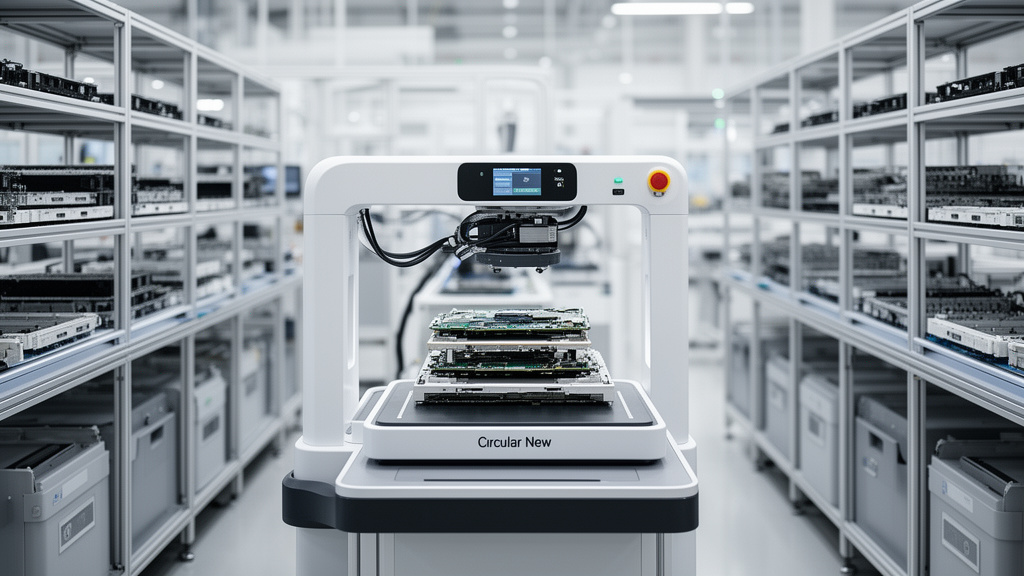
In a strategic move that could redefine the economics of sustainable production, Ricoh and ETRIA have officially unveiled ‘Circular New.’ This manufacturing initiative seeks to solve one of the most persistent hurdles in modern industry: how to maintain high-quality production outputs while drastically reducing reliance on virgin raw materials. By treating used market products not as waste, but as foundational assets for new production cycles, the partnership aims to lower carbon footprints through localized circular production loops, effectively turning environmental responsibility into a measurable competitive advantage.
Key Highlights
- Asset-Driven Production: The ‘Circular New’ concept transitions from a ‘take-make-waste’ model to an ‘asset-harvesting’ framework where used products provide the primary material streams for new manufacturing.
- Carbon Footprint Reduction: By localizing production loops, the initiative significantly cuts emissions associated with global logistics and raw material extraction.
- Competitive Advantage: Ricoh and ETRIA are positioning resource circulation as a core business strategy rather than a peripheral CSR goal, aimed at insulating the company from raw material price volatility.
- Localized Loops: The strategy emphasizes localized execution, allowing for shorter supply chains and more agile inventory management.
The Strategic Architecture of ‘Circular New’
The traditional manufacturing paradigm—linear and extractive—has long been a source of vulnerability for global electronics firms. As resource scarcity tightens and environmental regulations mount, Ricoh and ETRIA are leveraging the ‘Circular New’ concept to fundamentally restructure their operational DNA. This initiative is not merely a recycling program; it is an integrated manufacturing philosophy that embeds circularity into the design phase of the product lifecycle.
Moving Beyond Traditional Recycling
Standard recycling often involves breaking materials down to their raw states, which is energy-intensive and leads to material degradation. In contrast, ‘Circular New’ focuses on the strategic recovery of higher-value components. By identifying parts that retain their functional integrity, Ricoh and ETRIA can reintroduce these components into new production lines with minimal processing. This ‘upcycling’ approach maintains higher material quality and dramatically lowers the energy expenditure required for material synthesis. The entities involved are pioneering a system that views the entire global inventory of sold products as a decentralized, dormant warehouse of high-value parts ready for reclamation.
The ETRIA-Ricoh Synergy
ETRIA brings specialized technical capabilities in circular logistics and reverse manufacturing, while Ricoh contributes its vast infrastructure, historical commitment to environmental sustainability (often referred to internally as the ‘Comet Circle’), and deep manufacturing prowess. Together, they are creating a blueprint for what a ‘Circular-First’ factory looks like. This involves advanced AI-driven diagnostics to rapidly sort, assess, and qualify used parts for immediate reintegration. By bridging the gap between product end-of-life and factory beginning-of-life, the two companies are effectively shortening the supply chain to a singular, closed-loop process.
Competitive Advantage Through Circulation
The most compelling aspect of ‘Circular New’ is its framing: it is presented not as a compliance measure, but as a robust business strategy. In an era where supply chain resilience is paramount, the ability to generate parts internally from one’s own previous output provides a hedge against geopolitical instability, port congestion, and fluctuating commodity prices.
The Economic Case for Circularity
Economically, the model shifts the focus from ‘procurement’ to ‘recovery.’ While the initial setup for reverse logistics is complex, the long-term margin benefits are significant. By bypassing the need for new raw materials, the companies reduce the financial impact of raw material market volatility. Furthermore, the localized nature of these loops—processing used goods near the regions where they were initially consumed—significantly reduces carbon-heavy long-haul transportation. This is a crucial pivot in an age where Scope 3 emission reporting is becoming mandatory for large-cap firms. By shortening the physical distance between the discarded product and the new production line, Ricoh and ETRIA are optimizing for both cost and carbon efficiency.
The Future of the ‘Circular’ Factory
Looking ahead, ‘Circular New’ serves as a pilot for the broader manufacturing sector. The transition to this model requires a reimagining of product design—making items that are easier to disassemble and modular by default. This is the ‘Design for Circularity’ revolution. If this model succeeds, it suggests that the factories of the future will be less dependent on massive, centralized mining and refining operations, and more reliant on sophisticated, urban-based ‘recovery hubs’ that act as the mines of the 21st century. The partnership between Ricoh and ETRIA represents a critical inflection point: the moment when circularity stops being an ‘add-on’ and becomes the primary engine of manufacturing profitability.
FAQ: People Also Ask
Q: How does ‘Circular New’ differ from traditional recycling?
A: Traditional recycling typically breaks products down to raw materials. ‘Circular New’ prioritizes the retention of complex, functional components that can be immediately reused in new products, preserving value and reducing energy consumption.
Q: What is the primary environmental goal of this partnership?
A: The initiative focuses on a drastic reduction in virgin material usage and a corresponding decrease in carbon footprints, achieved through localized production loops that minimize shipping and raw material extraction.
Q: Is ‘Circular New’ just for Ricoh products?
A: While currently rooted in Ricoh’s ecosystem, the ‘Circular New’ concept is designed as a scalable manufacturing philosophy that could theoretically apply to a wide range of durable electronic goods, given the right technological infrastructure.
Q: How does this create a competitive advantage?
A: It creates an internal, reliable supply chain that is insulated from external commodity market volatility, reducing cost risks and enhancing supply chain resilience against global disruptions.