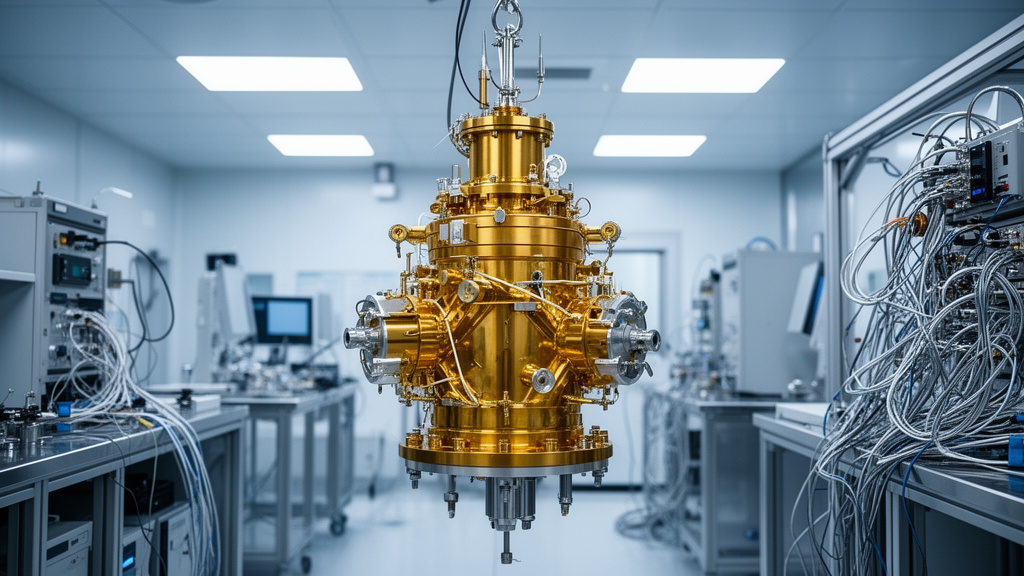
IQM Quantum Computers is navigating a pivotal phase as it balances significant R&D-driven operating losses against surging market demand, announcing a massive EUR 102.1 million order backlog in its H1 2026 financial report. This performance data provides a clear snapshot of a deep-tech enterprise in the midst of a transition from academic-focused development to industrial-grade commercialization, highlighting that while the financial burn rate remains high, the company’s technological proposition is gaining undeniable traction across global sectors.
Key Highlights
- Record Order Backlog: IQM Quantum Computers secured a robust order backlog totaling EUR 102.1 million as of August 3, 2026.
- Financial Performance: The firm reported an operating loss of EUR 60.5 million for the first half of 2026, consistent with the capital-intensive nature of quantum development.
- Revenue Metrics: Revenue for H1 2026 reached EUR 8.9 million, reflecting current conversion rates of R&D milestones into commercial output.
- Strategic Trajectory: The significant delta between current revenue and the order backlog suggests a massive pipeline of upcoming project delivery and hardware installation, positioning the firm for long-term scalability.
The Quantum Scaling Dilemma: Innovation vs. P&L
To understand the H1 2026 results for IQM Quantum Computers, one must first understand the fundamental economics of the quantum computing sector. Unlike traditional SaaS or software-based tech firms, quantum hardware companies operate at the bleeding edge of physics and engineering. They are not merely selling software licenses; they are building the physical infrastructure of the next computational paradigm. This requires enormous, sustained capital expenditure (CAPEX) on cryogenics, specialized fabrication, and top-tier talent, all of which contribute heavily to the EUR 60.5 million operating loss.
The Anatomy of the Order Backlog
The most telling metric in the recent report is not the revenue, but the EUR 102.1 million backlog. In the context of quantum hardware—where lead times for installation, calibration, and delivery are measured in months or years—a backlog is a more accurate leading indicator of success than quarterly revenue. This figure represents signed contracts, committed government projects, and industrial partnerships that have not yet fully recognized revenue.
For investors and industry analysts, this backlog signals a maturation of the market. It indicates that enterprises, national research bodies, and high-performance computing centers are moving beyond the “pilot phase” of quantum experimentation. They are committing capital to IQM’s roadmap, betting on the firm’s ability to deliver quantum advantage in practical, real-world applications. The shift from experimental “proof-of-concepts” to multi-million euro commitments is a critical milestone for any quantum pure-play.
The Revenue Gap: A Necessary Stepping Stone
While the EUR 8.9 million in revenue may appear modest against the operational loss, it must be viewed as the “tip of the iceberg.” In the lifecycle of high-tech manufacturing, revenue is often “lumpy,” recognized only when specific hardware milestones are met or systems are delivered and commissioned.
IQM’s business model is shifting from an R&D grant-dependent structure toward an industrial-delivery structure. The current financials reflect this transition: the company is currently burning cash to build the physical capacity necessary to fulfill the massive order book. The EUR 60.5 million loss is effectively the “cost of scaling,” representing investment in the next generation of Quantum Processing Units (QPUs) that will eventually fulfill those EUR 102.1 million in pending contracts.
Strategic Position and European Sovereignty
Beyond the raw numbers, IQM occupies a vital position within the European tech landscape. As nations increasingly prioritize technological sovereignty, particularly in sensitive fields like cryptography, materials science, and pharmaceutical simulation, the reliance on home-grown quantum infrastructure has become a geopolitical imperative.
IQM’s ability to generate a nine-figure backlog validates its position as a central player in the European Quantum ecosystem. By capturing this demand, IQM is not only building a business but also securing the necessary technical infrastructure for a future where quantum computing could become the backbone of national defense and economic competitiveness. Their partnerships across the continent are essentially de-risking the technology, proving that industrial giants are ready to integrate quantum workflows into their existing IT stacks.
Looking Toward the Horizon: Sustainability
The path to profitability for any quantum company is inextricably linked to the scaling of QPU performance—specifically, error correction and qubit counts. IQM’s ability to convert their EUR 102.1 million backlog into realized revenue will depend heavily on their operational efficiency over the next 18 to 24 months.
If the firm can maintain the pace of hardware delivery without blowing past their capital reserves, they are well-positioned to become the standard-bearer for European quantum computing. However, the market will be watching closely. The H1 2026 report serves as a “check-in” that confirms the product-market fit. The next report will need to show a narrowing of that operating loss as those backlog contracts begin to cross the finish line and hit the revenue sheet.
FAQ: People Also Ask
Q: What does a EUR 102.1 million backlog actually mean for a quantum company?
A: It represents the total value of orders, contracts, and agreements that IQM has signed but has not yet completed or recognized as final revenue. It is a critical metric for long-term growth, signaling future income and strong demand for the company’s hardware.
Q: Is an operating loss of EUR 60.5 million normal for a company like IQM?
A: Yes. In the deep-tech and quantum hardware sector, companies are characterized by heavy investment in research, specialized infrastructure, and high-end talent. Significant early-stage losses are common as companies scale their R&D and manufacturing capabilities before reaching mass-market commercialization.
Q: What is the main driver of IQM’s revenue growth?
A: Growth is driven by the increasing demand from industrial and academic entities for high-performance quantum computing systems. As organizations move to integrate quantum into their research workflows, they are signing long-term service and hardware delivery agreements with IQM.
Q: How does this H1 2026 report impact the European quantum market?
A: It serves as a strong indicator that the European quantum market is maturing. The size of the order book demonstrates that there is real, paying demand for quantum technology, which helps validate the broader European ecosystem for quantum sovereignty and competitiveness.