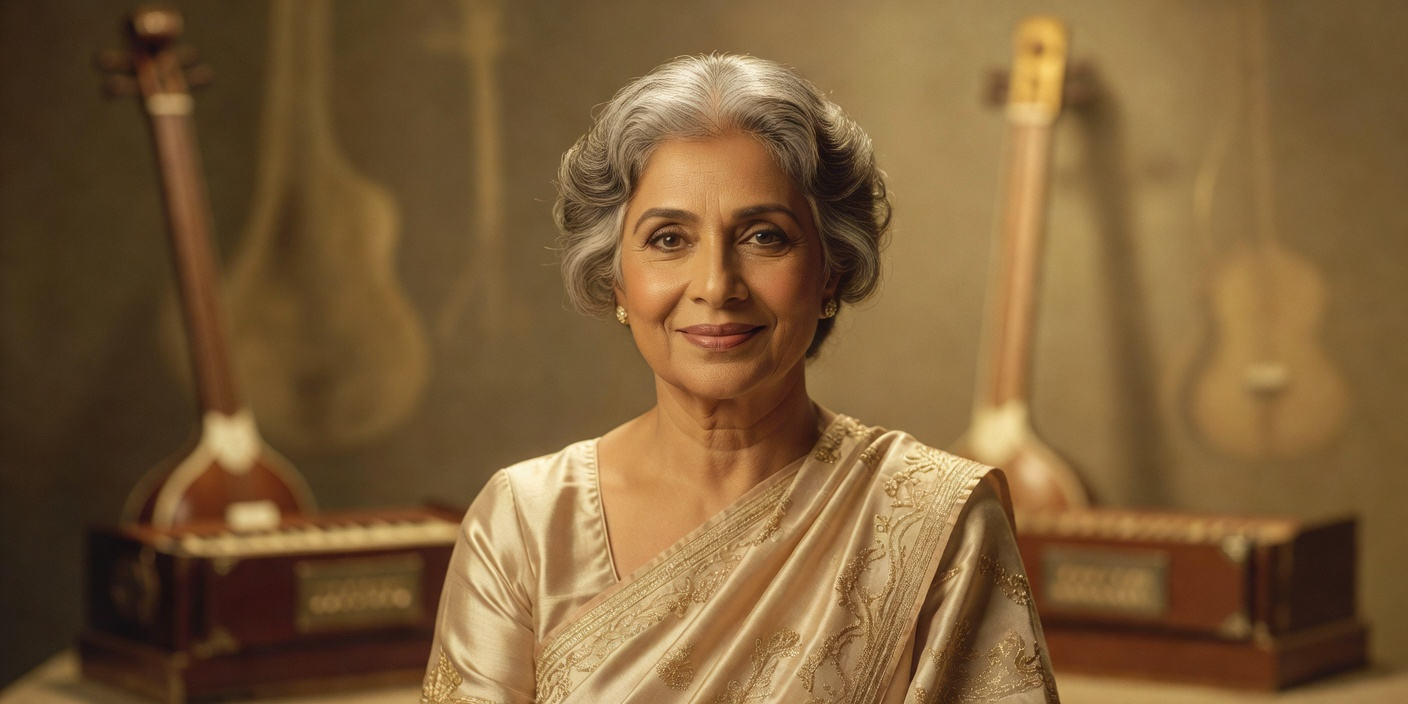
The world of music and the heartbeat of Indian cinema have gone silent with the passing of Asha Bhosle, the legendary playback singer who breathed her last on April 12, 2026, at the age of 92. Admitted to Mumbai’s Breach Candy Hospital due to extreme exhaustion and a chest infection, the icon eventually succumbed to multi-organ failure. Her departure marks the end of an extraordinary epoch in global music, leaving behind a legacy that spanned over eight decades and encompassed more than 12,000 songs. As the nation prepares to bid a final farewell with state honors at Shivaji Park today, the magnitude of her contribution—from the sultry cabaret numbers of the 70s to the classical ghazals of the 90s—is being mourned by millions worldwide.
Key Highlights
- Passing of a Legend: Asha Bhosle died at 92 on April 12, 2026, at Breach Candy Hospital, Mumbai, following multi-organ failure.
- Unmatched Versatility: Known for singing over 12,000 tracks, Bhosle’s range spanned genres from Bollywood cabaret and pop to traditional Indian classical and folk music.
- State Honors: The Indian government and Maharashtra state officials have announced that her final rites will be conducted with full state honors at Shivaji Park.
- Global Influence: Beyond Indian borders, she influenced Western artists like Cornershop and collaborated with modern acts like Gorillaz, bridging generations and continents.
A Voice That Defined Generations
The story of Asha Bhosle is not merely one of a singer; it is the story of the sound of a developing nation. Born on September 8, 1933, into the illustrious Mangeshkar musical dynasty, Asha faced the monumental challenge of carving out an identity in the shadow of her elder sister, Lata Mangeshkar, who was revered as the “Nightingale of India.” Yet, where Lata was often the voice of the virtuous, traditional heroine, Asha carved a rebellious, kaleidoscopic path for herself. She brought a distinctive, intoxicating energy to her recordings, embracing the complex requirements of cabaret, jazz, and rock-influenced melodies that defined the rebellious spirit of Hindi cinema in the 1970s.
The Cabaret Queen and Beyond
In the 1970s, as Indian cinema embraced bolder narratives, Asha Bhosle became the voice of the “vamp” and the independent woman. Songs like “Dum Maro Dum” and “Yeh Mera Dil” were not just musical hits; they were cultural phenomena that redefined the female persona on the Indian screen. She possessed an uncanny ability to morph her voice to suit the actress on screen, infusing personality, flirtation, and depth into every syllable. While many singers of her era were confined to romantic ballads, Bhosle’s range allowed her to experiment with Western arrangements, funk, and even fusion, working alongside maestros like R.D. Burman—who would later become her husband—to create soundscapes that were decades ahead of their time. Her contribution was not restricted to Hindi; she recorded in Marathi, Bengali, Tamil, and a host of other languages, ensuring that her voice was the constant thread in the diverse tapestry of Indian culture.
Breaking Barriers and Global Reach
Unlike many of her contemporaries, Bhosle was never afraid of evolution. In the late 1990s, when she might have been expected to retire, she instead found a new audience in the West. The British band Cornershop immortalized her name in their 1997 hit “Brimful of Asha,” introducing her to a global demographic that had never heard a Bollywood playback track. This was no fluke. She continued to collaborate with Western artists, including a recent feature on the Gorillaz album The Mountain (Parvat). These collaborations were not desperate attempts at relevance but reflections of her perpetual youthfulness. She had an innate, childlike curiosity that saw her embracing digital production, experimental electronica, and cross-cultural collaborations with the same enthusiasm she brought to her early sessions in the 1950s. She was, in every sense, a modern artist who happened to have a foundation in the classics.
The Final Journey
Her final days were spent in Mumbai, a city that she had helped define. The outpouring of grief from Prime Minister Narendra Modi, Bollywood stalwarts like Shah Rukh Khan and Amitabh Bachchan, and sports personalities underscores her status as a national treasure. The decision to grant her state honors is a reflection of her status not just as an entertainer, but as a cultural pillar whose music acted as the soundtrack to the lives of generations of Indians. Her home in Lower Parel has become a site of pilgrimage for fans who grew up on her songs, from the romantic “Chura Liya Hai Tumne” to the soul-stirring “Dil Cheez Kya Hai.” As the final procession moves toward Shivaji Park, the mood is one of profound collective loss—a realization that the voice that narrated the romance, the tragedy, and the joy of millions has finally gone quiet.
FAQ: People Also Ask
- What was the cause of Asha Bhosle’s death?
Asha Bhosle passed away due to multi-organ failure. She had been admitted to Breach Candy Hospital in Mumbai on April 11, 2026, following extreme exhaustion and a chest infection.
- Where will the funeral of Asha Bhosle take place?
The funeral rites are being held today, April 13, 2026, at Shivaji Park in Mumbai with full state honors. Her mortal remains were kept at her residence in Lower Parel earlier in the day for the public to pay their final respects.
- What awards did Asha Bhosle receive during her career?
Bhosle was a recipient of the prestigious Dadasaheb Phalke Award, India’s highest cinematic honor. She was also awarded the Padma Vibhushan and received multiple National Film Awards and Grammy nominations throughout her illustrious career.
- How many songs did Asha Bhosle record in her lifetime?
By her own estimation and official records, Asha Bhosle recorded over 12,000 songs across a career that spanned nearly eight decades, covering multiple Indian and international languages.