Nepal’s Prime Minister K.P. Sharma Oli has resigned, succumbing to immense pressure following days of unprecedented and violent anti-corruption protests that gripped the nation. The resignation, announced on Tuesday, September 9, 2025, came after protests, spearheaded by the youth demographic dubbed ‘Gen Z,’ escalated dramatically, leading to significant loss of life, widespread destruction of property, and a severe security crisis in the capital, Kathmandu.
The Spark That Ignited a National Uprising
While the immediate trigger for the widespread unrest was a controversial government ban on 26 social media platforms, including Facebook, WhatsApp, and X, the underlying issues fueling the demonstrations ran much deeper. The ban, quickly reversed by the government, was perceived by many as an attempt to stifle dissent and suppress criticism of alleged rampant corruption and nepotism among the country’s political elite. This move, coupled with viral social media content showcasing the extravagant lifestyles of politicians’ children, ignited a powder keg of public frustration.
Gen Z Leads the Charge Against Corruption
What began as a youth-led protest movement quickly transformed into a national outcry against what many Nepalis see as a corrupt and detached political class. Demonstrators, many in their late teens and early twenties, took to the streets, not just to protest the social media ban, but to demand accountability for decades of alleged corruption and poor governance. Slogans like “Stop corruption, not social media” and “KP Chor, Desh Chodd” (“KP thief, leave the country”) echoed through the capital. The movement, described as a national phenomenon involving “Gen Z” and their parents, demonstrated a broad societal disillusionment.
Escalating Violence and State Response
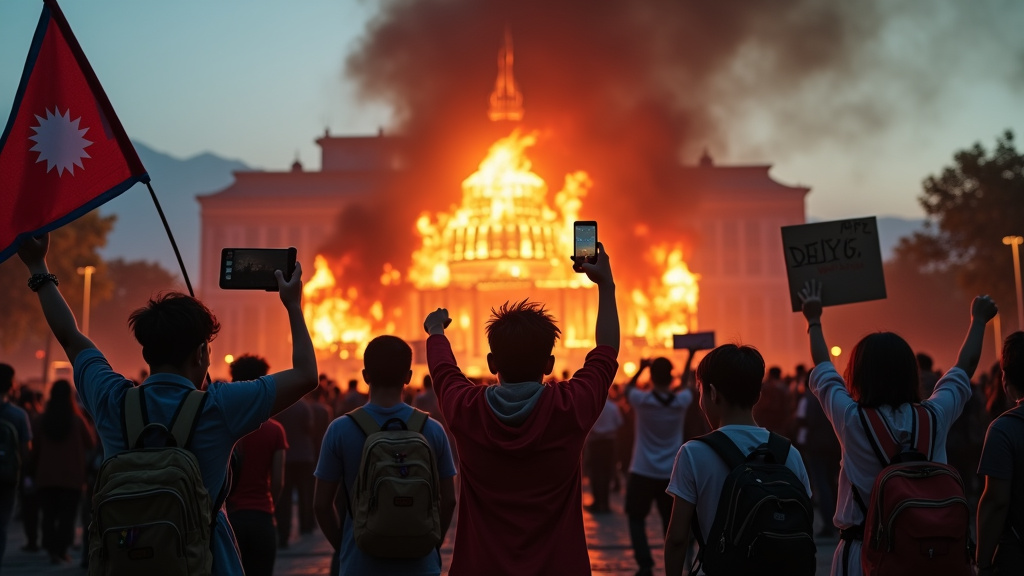
The protests rapidly devolved into violent clashes. Eyewitness accounts and reports indicate that security forces responded to demonstrators with lethal force, including live ammunition, rubber bullets, and tear gas. The violence resulted in the deaths of at least 19 to 25 protesters, with hundreds more injured, many critically. In a significant escalation, protesters stormed and set fire to the federal parliament building, the Prime Minister’s official residence, and the homes and offices of several prominent politicians and party headquarters. The chaos prompted the Nepal Army to deploy troops across Kathmandu and other key cities to restore order, imposing a nationwide curfew and prohibitory orders.
Airports Shut, Borders Tense
The unrest had a direct impact on national infrastructure, with Tribhuvan International Airport in Kathmandu shut down indefinitely, leading to the cancellation of all domestic and international flights and stranding thousands of passengers, including tourists. The Nepal Army took control of the airport premises to ensure security. India, Nepal’s neighbor, also heightened security along its extensive shared border in response to the escalating instability.
Prime Minister Oli’s Resignation and Calls for Dialogue
Faced with the deepening crisis, Prime Minister K.P. Sharma Oli submitted his resignation letter to President Ramchandra Paudel, stating his intention to “facilitate a solution to the problem and to help resolve it politically.” The President accepted the resignation and urged all stakeholders, including protest leaders, to engage in peaceful dialogue. Senior government officials, including the Home Minister, also resigned, taking moral responsibility for the bloodshed.
Underlying Discontent and Future Uncertainty
Nepal has long grappled with political instability and economic challenges, with a significant portion of its economy reliant on remittances from citizens working abroad. Allegations of corruption and a perceived lack of progress on critical issues have festered for years. Oli’s own tenure has been marked by controversies, including accusations of cronyism and authoritarian tendencies. His resignation leaves Nepal facing a period of political flux, with questions arising about the formation of a new government and the path forward for the Himalayan nation. The “Gen Z” protests, now widely covered as trending news, have undeniably brought long-standing grievances into the spotlight, demanding a fundamental shift in how the country is governed. The future trajectory of Nepal’s governance and its fight against corruption remains uncertain following this dramatic turn of events, which has captured international news attention.
Keywords: top, trending, viral, spotlight, hyped, news
This news is undoubtedly trending globally. The viral videos of protests and the subsequent resignation have put Nepal in the spotlight. The hyped “Gen Z” movement against corruption is now a major news story, highlighting the top issues facing the nation.