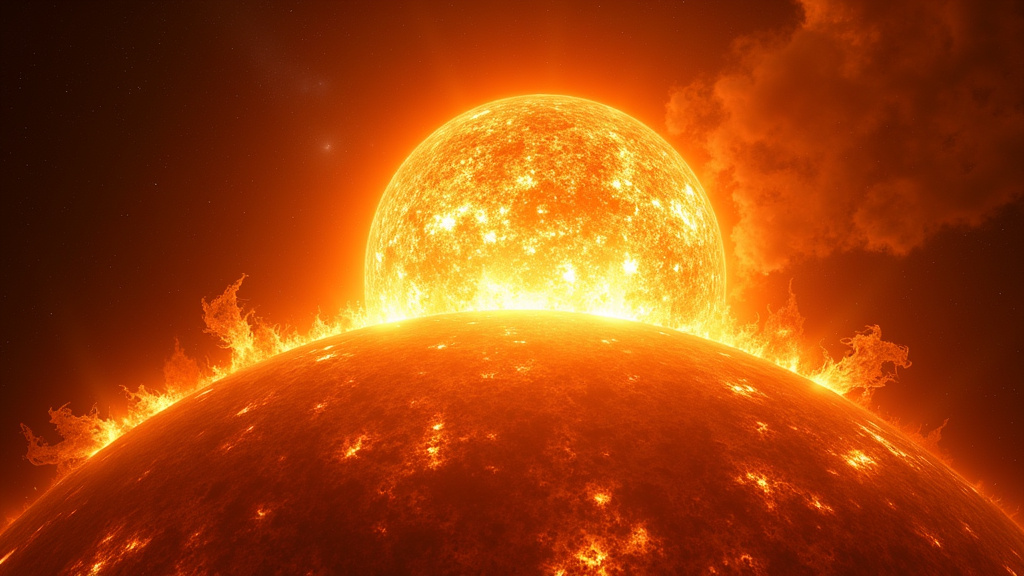
A powerful X1.9 **solar flare** erupted on December 1, 2025, registering as R3-Strong, which signals significant radio disruption. The National Oceanic and Atmospheric Administration’s (NOAA) Space Weather Prediction Center (SWPC) confirmed this intense **solar flare** event shortly after its occurrence. The eruption originated from an unnumbered active region just rotating onto the sun’s visible disk in the northeast quadrant. Understanding the impact of a **solar flare** is crucial.
Understanding the Solar Fury of a Solar Flare
Solar flares are immense bursts of energy originating from the Sun’s atmosphere, typically in active regions hosting sunspots with intense magnetic fields. The sudden release of this magnetic energy causes the **solar flare**. Flares emit radiation across the spectrum, with X-class flares being the most powerful type, ten times stronger than M-class flares. The number following ‘X’ indicates intensity; an X1.9 **solar flare** is highly potent, unleashing vast amounts of energy that travel at the speed of light.
Solar Cycle 25 Activity and Solar Flares
We are currently in Solar Cycle 25, which began in December 2019 and is expected to continue until about 2030. Solar Cycle 25 has shown surprisingly strong activity, with sunspot numbers rising significantly, contrary to initial predictions of a weaker cycle. Solar maximum, the peak of activity, was anticipated around July 2025, and this major global event, a significant **solar flare**, fits within this heightened period. Active regions produce these energetic phenomena, and the unnumbered region that produced this recent **solar flare** suggests a newly developing or less studied area, making close monitoring crucial as such regions can continue producing strong flares.
The R3-Strong Impact: Radio Blackouts from a Solar Flare
The R3-Strong classification points to a significant radio blackout caused by the **solar flare**. This event directly impacted Earth’s ionosphere, as high-energy X-rays and ultraviolet radiation ionized the upper atmosphere. This ionization disrupts High Frequency (HF) radio communications. Limited blackouts can last for tens of minutes to hours, primarily affecting the sub-solar point, the area directly facing the sun. Such disruptions from a **solar flare** can interfere with navigation systems and impact satellite communications, a key concern for global events reliant on stable signals.
Wider Technological Concerns from Solar Flare Events
Beyond radio disruptions, stronger **solar flares** pose broader risks. They can damage Earth-orbiting satellites, as high-energy particles can corrupt sensitive satellite components. Power grids are also vulnerable; geomagnetic storms, often following flares, can induce currents that cause widespread power outages, as demonstrated by the 1989 Quebec blackout. Astronauts in space face increased radiation risks from a **solar flare** and may need to seek shelter. High-altitude flights can also experience minor radiation exposure, and while effects on personal electronics are less direct, system glitches are possible.
Monitoring and Future Solar Flare Eruptions
NOAA’s Space Weather Prediction Center (SWPC) plays a vital role in monitoring **solar flare** activity, issuing alerts, watches, and warnings. NASA contributes through solar observation missions, with satellites constantly monitoring the sun for potential **solar flare** events. This vigilance is essential for anticipating space weather. Active regions that produce X-class flares often remain active and can erupt again. Therefore, scientists will closely watch this unnumbered region, as future **solar flare** events are possible in the coming days. These events are major space weather phenomena worth following.
Staying Prepared for Solar Flare Impacts
This X1.9 **solar flare** highlights our reliance on technology and underscores the dynamic nature of space weather. Understanding these phenomena is key to preparing for potential impacts. The SWPC provides critical updates, and staying informed about space weather trends, including recent **solar flare** activity, is increasingly important to mitigate risks to our interconnected world. It’s a trending topic in science news, and such major events serve as powerful reminders of the Sun’s influence, including the occurrence of a significant **solar flare**.